Portable Cabin Prices: Karmod Container Cabins by Layout and Size
Karmod container cabin prices by layout and size, what electrics, heating and fittings add, what the listed price leaves out, and how to get a firm quote.
Guide
How long you need it, how often you will reuse it and who looks after it between jobs: what decides whether to buy or hire a site cabin, with a fill-in cost comparison.
Whether to buy or hire a site cabin comes down to how long you need it, how often it will be used again and who looks after it between jobs. Hiring hands most of the work of ownership to someone else for a set period. Buying costs more at the start but leaves you with a unit you can move to the next project or sell. Below are the factors and a way to compare the two with your own figures.
Hire charges run for as long as the cabin stays, so a short job with a fixed end date usually favours hiring. A purchase price is paid once, so the longer the cabin is in use, the more weeks it is spread across.
Reuse matters as much as the length of one job. A cabin bought for one short project that then sits idle is expensive to own. One that moves from job to job earns back part of its price on every project.
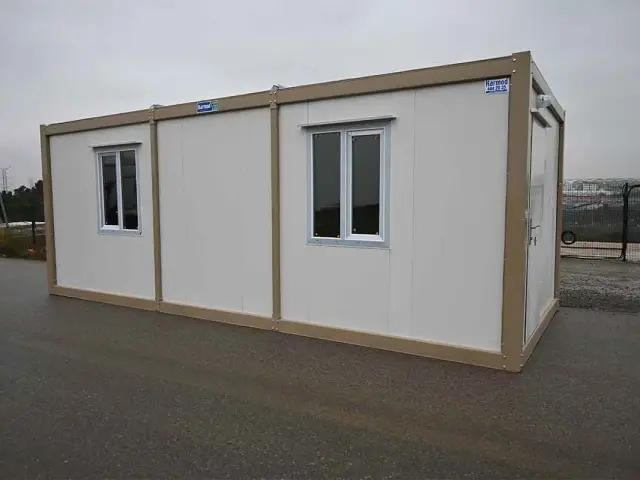
One site at a time with long gaps between jobs gives owned cabins little to do. Several sites at once, or jobs back to back, let the same office or welfare unit go straight from one compound to the next. Every Karmod container layout shares the same four footprints, so a compound planned around one set of offices and welfare units can be laid out again at the next site.
When you hire, you normally choose from the units available. When you buy, you pick the closest layout, such as an office with a private office or a welfare unit with two entrances, and add options such as an electrical pack, an electric wall heater or air conditioning, plus a kitchen unit or a toilet and sink unit on the layouts that offer them. Changes such as a different door position are confirmed on a drawing before production.
A bought cabin still has value when the job ends: you can move it to the next site, use it at your yard or sell it. Its resale value depends on condition, layout, demand and the cost of getting it to a buyer, so use a cautious estimate, or the hire charges you would avoid on the next project if you plan to reuse the unit.
Under many hire agreements the hire company looks after servicing and normal wear and charges the hirer for damage, so read the terms. When you own the cabin, upkeep is yours: locks, window seals, floor coverings, cleaning between jobs, frost protection for water pipes and periodic checks of the electrics by a qualified electrician.
Every move of an owned cabin is a delivery in its own right: services disconnected, a HIAB or crane lift and a prepared base at the next site. With hire, the hire company usually delivers and collects, and you pay for both. If you buy, you also need somewhere secure and level to keep the cabin between jobs. Our guide to preparing your site for cabin delivery covers what each move involves.
Hire agreements often require the hirer to insure the cabin or pay a damage waiver, so check what is covered. An owned cabin needs cover on site, in transit and in storage, so ask your insurer. Karmod container layouts have a steel entrance door as standard, but a cabin standing empty between jobs still needs locking and regular checks.
Hiring turns the cost into regular charges that stop when the job ends and can be charged to one project. Buying means paying the purchase price at the start rather than spreading it over the job, unless you use finance, and puts an asset on your books. Ask your accountant how each option affects your accounts and tax, including whether capital allowances apply. Compare both sides on the same VAT basis: Karmod prices exclude VAT, delivery and offloading, so set out hire quotes the same way.
Put both options side by side over the same period, and leave out costs you pay either way, such as the base, connecting services, power and day-to-day cleaning. Whichever you choose, the units must still meet the construction site welfare requirements for your project.
Cost of hiring: H = (W × r) + Dh + Ch
Net cost of buying: B = P + D + (n × m) + S + R + I − V
| Letter | What it is | Source | Your figure |
|---|---|---|---|
| W | Weeks the cabin is needed | Your programme | weeks |
| r | Weekly hire charge, including any damage waiver or insurance the hire terms require | Hire quote | £ |
| Dh | Total hire delivery charges, one for each job | Hire quote | £ |
| Ch | Total hire collection charges, one for each job | Hire quote | £ |
| P | Purchase price of the unit and its options | Purchase quote | £ |
| D | Delivery and offloading | Formal purchase quote | £ |
| n × m | Further moves, including taking the cabin off site at the end, times the cost of each | Your plans and a transport quote | £ |
| S | Storage between jobs | Your yard or a storage quote | £ |
| R | Maintenance and repairs | Your allowance for the period | £ |
| I | Insurance for the period | Your insurer | £ |
| V | Resale value, or hire avoided on the next job | Your cautious estimate | £ |
If B is lower than H, buying costs less over the period; if H is lower, hiring does. If they are close, the other factors above usually decide.
Say the job needs a self-contained office with its own toilet. A K2004 Site Office with WC & Kitchenette at 3.00m × 6.00m is £8,640 + VAT. With the standard electrical pack (£1,050 + VAT) and an electric wall heater (£375 + VAT), P = £8,640 + £1,050 + £375 = £10,065 + VAT, the sum of the listed prices before delivery and offloading. D comes from the formal quote for your postcode and the other letters from your own plans; on the hire side, take r, Dh and Ch from a quote for a comparable unit.
To see how long the cabin must be in use before buying costs less, solve for W:
Break-even weeks = (B − Dh − Ch) ÷ r
Longer use, on one job or across several, favours buying; shorter use favours hiring. S, R and I grow with time, so work out B for the length of use you expect and recalculate if the answer is far from it. Try V at zero to see how much resale matters.
| Buying tends to suit | Hiring tends to suit |
|---|---|
| A long programme, or one likely to be extended | A short job with a fixed end date |
| Several sites at once, or jobs back to back | One site, with a long gap before the next |
| A particular layout or fit-out | Any standard unit will do |
| A yard to store it and a way to move it | No storage and no wish to organise moves |
| Cash or finance available now | Cost must be spread or charged to one job |
You can own the units every job needs, such as a site office and a welfare unit, and hire extra cabins only for the busiest phase of a large project. The units you would need on every site over the next few years are the ones worth pricing for purchase. Our site office cabins and welfare cabins and WC units pages list the layouts with their prices.
To fill in P and D, choose a layout, size and options and send a request through our quote page. Sending a request does not commit you to anything, and the formal quote confirms delivery to your postcode and the offload equipment needed. For what changes a cabin's price, see our portable cabin price guide. For other questions, contact our team or call 0116 403 0143, Monday to Friday, 8am to 6pm.
Neither costs less in every case, which is why the comparison on this page uses your own quotes. If the programme could overrun, run it at the planned length and again at the longest likely length. Each extra week on site adds another week of hire, while on the buying side only upkeep and insurance carry on, so an overrun usually moves the answer towards buying.
Yes, if you would use a loan or other finance to buy the cabin. Add the interest and any fees for the period to the buying side alongside P; your lender can give you those figures. If you would pay cash, remember that the money is then tied up in the cabin rather than available for other work.
Not automatically. In England, the temporary permitted development that covers site buildings lasts only as long as the works, and the cabin must then be removed. Keeping it as a permanent office, store or mess room, on that site or at your yard, is a new planning question, and Building Regulations may then apply. Wales, Scotland and Northern Ireland have their own rules. Wherever you are, confirm with your local planning authority and building control before you count on keeping it. Our guide to portable cabins on private land explains more.
No. In England, Scotland and Wales, CDM 2015 requires the welfare facilities in its Schedule 2 throughout the construction phase, whether the units are owned or hired. The principal contractor must ensure they are provided, and every contractor must ensure, so far as is reasonably practicable, that Schedule 2 is met for itself and its own workers, which covers projects with only one contractor. Northern Ireland has its own Construction (Design and Management) Regulations (Northern Ireland) 2016, with minimum welfare facilities in Schedule 3. This comparison only decides how you pay for the units, not how many you need.
No. W is the number of weeks you would otherwise be paying hire, so count only the weeks the cabin is needed on site. A hired cabin would have gone back between jobs, so idle weeks cost nothing on the hire side; put the cost of keeping an owned cabin through them into S, R and I.
As near as you can get. Compare the same size and the same facilities on both sides. If the hire unit lacks something the bought unit includes, such as a WC or kitchenette, add the hire of a separate unit that provides it to H, with its own delivery and collection.
Karmod container cabin prices by layout and size, what electrics, heating and fittings add, what the listed price leaves out, and how to get a firm quote.
The full welfare checklist for GB construction sites under CDM 2015: what each facility involves, who must provide it from day one, and the Karmod units that cover it.
Portable cabin, container office or modular building? What each term means, how Karmod's units are built, and which type suits a site, a gate or a garden.
Talk to our UK team
Tell us what the building is for and where it is going. We will suggest a unit, check delivery and send a formal quote.